Blocked at the door
The check happens while the connection is being opened, not in hindsight. If the destination matches the ruleset the connection is refused on the spot, and no traffic ever leaves your device.
Compliance
What is my connection actually used for, can it get me into trouble, and how do you police it? This page answers all three. Node owners share exit bandwidth that carries ordinary network requests from platform customers. We block high-risk destinations by domain at the gateway, restrict which connections may enter the dispatch pool, require verified identity on every account, and write every policy and money operation to an audit log.
0
Outbound blocklist rules live today
0
Documents you must accept on first launch
0s
Worst-case convergence for policy changes
SHA256
Integrity digest computed per legal document
These are the mechanisms in force today; the rule count keeps growing as governance requires. Nothing on this page is a promise of earnings.
Outbound control
We maintain a single outbound domain ruleset. Once written centrally it is broadcast over a publish/subscribe channel to every gateway, and each gateway matches the destination domain at the moment a connection is opened — a match is refused outright. Adding a rule needs no restart and no device reconnect: it takes effect the instant the broadcast lands. The first 101 rules are already live.
The check happens while the connection is being opened, not in hindsight. If the destination matches the ruleset the connection is refused on the spot, and no traffic ever leaves your device.
The ruleset lives centrally and every change is pushed to all gateway processes over pub/sub. One new rule is enforced immediately, with no service restart and no waiting for devices to reconnect.
A match returns an explicit TARGET_DENIED. The client is not re-dispatched to a different device to try again, so your phone is never used to hammer at a destination that has already been refused.
Rule syntax is validated once in the admin console and again on the server. Malformed rules cannot be saved, so a typo can never take legitimate domains down with it.
To be precise: this is real-time domain matching at the gateway, not access logging. We do not record destination URLs or payload content, and the block itself leaves no browsing record. Equally, it is not a "zero-log" system — for billing we meter traffic in MB and write it to settlement windows, and we record whether a device is online and running.
Three forms cover different scopes, and the console validates against the same grammar before saving.
| Form | Written as | What it matches |
|---|---|---|
| Exact | example.com | That domain only; subdomains are unaffected |
| Suffix | +.example.com | The domain plus every subdomain at any depth |
| Single wildcard | *.example.com | * matches exactly one label: a.example.com matches, a.b.example.com does not |
Informed consent
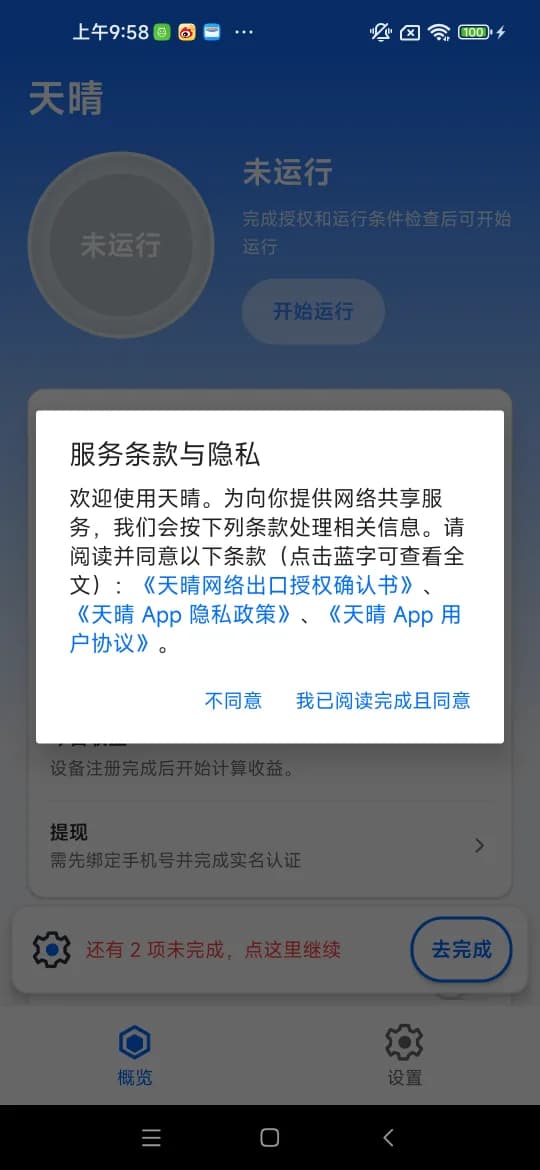
The first time the app opens you hit a consent gate: decline and nothing works. And it is not one catch-all agreement — three separate documents are presented on their own terms.
Account rules, what you may and may not do, how violations are handled, and how to leave at any time.
What the app collects, why, where it is stored, and the rights you can exercise over it.
The document specific to node owners. It states plainly that your connection will carry compliant network requests on behalf of platform customers, and takes your authorisation for exactly that. It is never folded into the other two — separate document, separate confirmation.
Per-document integrity check
The server computes a content_sha256 for each document; the client recomputes and compares it on fetch, and refuses to display anything that does not match.
Versions are never reused
One publish equals one globally unique version covering the complete document set. A version number is never reused, so it stays possible to establish exactly which text a given device accepted.
Live the moment it ships
After a new version is published, devices that have not accepted it receive CONSENT_REQUIRED on their next API call and must walk the consent flow again before they can keep running.
Do not confuse the two sets: these three in-app documents are for node owners, while the terms and privacy policy on the main site are for platform customers. They are published and maintained separately.
Identity
Verification attaches to the phone-number account, not to any single device. One account can carry several devices and you verify once. Verification must be complete before you can withdraw.
Earnings are paid out as real Alipay transfers, so the payee has to be verifiable — and if something goes wrong, responsibility has to trace back to a real person.
Withdrawals require an Alipay account plus the payee's legal name. Alipay verifies the name itself and rejects the transfer outright on a mismatch, so money cannot land in someone else's account.
Payout accounts and names are always masked in the admin console (138****1001, Chen*). Reviewers approve on that basis and never see the full details.
You can run a device without binding a phone number, but the dashboard will then only count that handset and you cannot withdraw. Bind a number and verify to pool earnings across every device on the account. Any personal income tax or other levies arising from a payout are declared and borne by the payee, as required by law.
Eligibility
Not every connection qualifies. Carrier admission is on by default: we resolve which network an exit IP belongs to, and only listed broadband exits take part in dispatch.
A device outside the pool still shows as online, but proxy requests never reach it: it is flagged isp_error and earns nothing. The only fix is to move it onto a listed home broadband line or mobile data.
Every registered device sits in exactly one of these states, and every transition is logged.
| State | Meaning | Effect on dispatch |
|---|---|---|
active | Connected and past carrier admission | Takes traffic; settled on what it actually carries |
revoked | Unbound by the owner or reclaimed | Leaves the pool and receives nothing further |
blocked | Banned for a violation, by device or by exit IP | Dropped from the gateway as soon as the ban is broadcast |
Admission-policy edits are not force-broadcast: gateways re-read them on their heartbeat, so worst case they converge in about 15 seconds. Bans are broadcast immediately and do not wait for a heartbeat.
Audit trail
Every back-office action touching permissions, policy or money writes an audit record with the operator, the timestamp and what changed. Reconstructing who changed what, and when, never depends on anyone's memory.
Withdrawals add idempotency on top: one withdrawal always maps to one merchant order number, and platform and payment-channel references resolve to each other in both directions. When a payout result is uncertain the request stays in "paying" until the payment channel gives an authoritative answer — we never guess, which is what keeps a payout from going out twice. Points from rejected or failed payouts are returned per request.
Data handling
Data is held on servers inside mainland China. The list below is deliberately specific: what is named is collected, and what is not named is not.
This page covers only the data handling tied to node operation; the privacy policy remains the authoritative statement.
Operator and filing
The Node Program is operated by the entity below, and the ICP filing can be verified directly with the Ministry of Industry and Information Technology.
Operating entity
海南高峰鑫田商贸有限公司
ICP filing
琼ICP备2025057067号-1Official domain
www.gaofengxt.cn
Support email
support@gaofengxt.cnThese apply to platform customers and site visitors. They are a separate set from the three in-app consent documents — do not read one as the other.
Compliance Q&A
Straight answers, each based on a mechanism that is live in production today.
Compliance runs both ways: we publish the rules, you join on those terms. Next, check the device requirements on the download page or look up your case in the FAQ.